Uncategorized
YONKERS, NEW YORK USA – A landslide occurred when a portion of a stone retaining wall 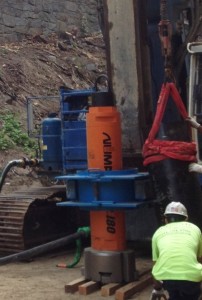 collapsed in Old Croton Aqueduct State Historic Park, sending mud and debris up against a senior housing complex. The 150 year old wall appears to have given way due to saturated ground conditions caused by a leaking water pipe, recent heavy rains, and melting snowpack resulting from higher temperatures. The collapse sent a wall of debris 24 feet (7 m) wide down an embankment and deposited 4 to 6 feet (1.2 – 1.8 m) of mud up against the housing complex. The mud and debris blocked access doors to the building and caused possible structural damage resulting in the dislocation of approximately 110 residents. Luckily, no injuries were reported.
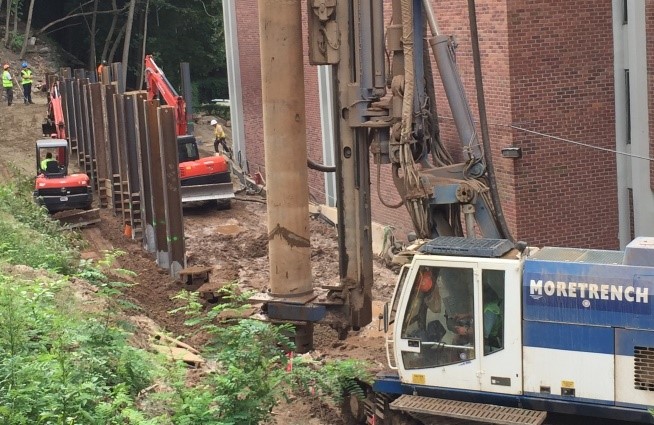
After clean-up was complete, the old retaining wall needed to be addressed to prevent future issues. The State of New York, responsible for the property, contracted with industry leader Moretrench to drill 97 holes for a new retaining wall. Moretrench is a nationally renowned geotechnical contractor specializing in design/build solutions to meet the diverse conditions and construction challenges that impact so many of today’s projects.
With other portions of the 150 year old wall at significant risk of collapsing, the Moretrench team got to work. The new retaining wall project called for the installation of 24” OD x 23” ID casing adjacent to the previous wall. Once drilled, H-Beams were to be grouted into place to provide the necessary support for the new retaining wall.
The Yonkers site presented many challenges with significant sloping and unstable terrain. The environment required Moretrench to build an earthen bench to provide a safe, flat drilling pad for the work required. A Bauer Track Rig RTG RG 19T was used to complete the bench and drilling was completed with the same rig with two Doosan HP 1600CFM/200PSI (1510 l/sec, 13.8 bar) compressors added.
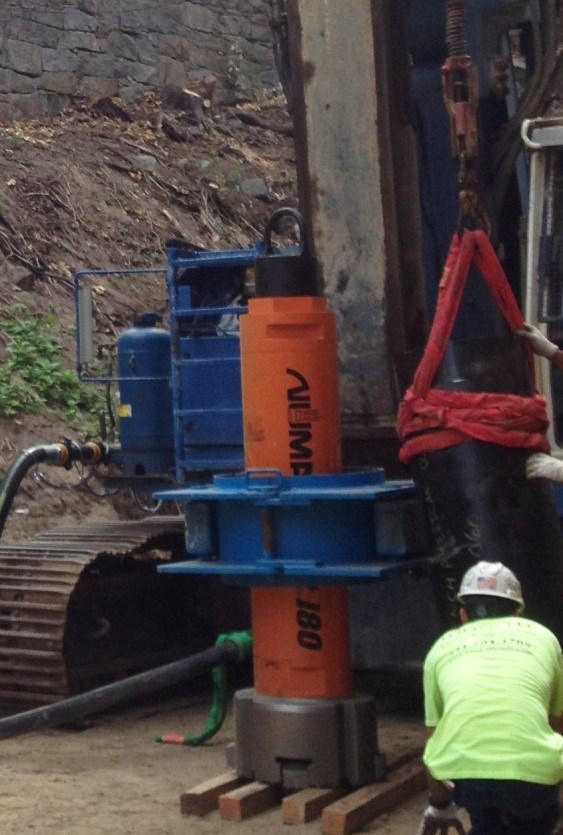
The ground formations at the site were varied, consisting of gravel, boulders, backfill, and rock pads. To conquer this, Moretrench teamed with DTH technology leader, Numa, and distributor Star Iron Works to drill with Numa’s Patriot 180 hammer and T580ND Super Jaws Overburden Bits. “On previous projects, we found Numa’s Super Jaws to be the best method for drilling in loose, unconsolidated ground conditions,” commented Moretrench’s Mike Fattorusso, Project Manager. “And Super Jaws did not disappoint at the site in Yonkers, providing great performance in a difficult environment.” In addition to great products, Numa also provided on-site support with Construction Product Manager Kris St. Onge who provided insightful, technical expertise. 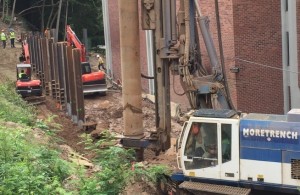
A total of 59 holes were drilled to a depth of 20 feet (6 m) and another 38 holes were drilled to 30 feet (9 m). Instead of using a multi-step process of drilling, tripping out of the hole, and then casing, the Super Jaws bits allowed for simultaneously drilling and casing in one step. Super Jaws makes this possible due to its unique wing design that retracts back into the guide body for extraction of all tooling while leaving the casing in place. A further challenge with drilling was with the confined site at the base of the previous wall that required a ½” (12.7 mm) tolerance and little room for error. But this was no challenge for Numa’s products with Fattorusso commenting, “The Patriot Hammer and Super Jaws bit drilled flawlessly straight holes allowing us to avoid delays caused by making corrections along the way. We simply were able to drill faster with Numa.”
For more information on Numa products and services, please email us at info@numahammers.com, call us on 860.923.9551, or visit our website at www.numahammers.com.
ABOUT NUMA
Numa is the global leader in the design and manufacturing of down hole hammers and bits for drilling vertical, horizontal, and reverse circulation holes from 3½ to 48 inches (89 – 1,219 mm) in diameter. Numa’s products are used in over 105 countries drilling in a wide range of industries including Construction, Foundation, Micro Piling, Oil & Gas, Quarry, Mining, Utility, Geothermal, Environmental, Horizontal, and Water Well.
Foremost to the success of our customers is Numa’s personal service and technological expertise. Numa is dedicated to supporting customers on the job site and is constantly talking to drillers around the world to get first hand input about the products required for today’s demanding drilling environment. Being so close to drillers’ needs has allowed Numa to develop 13 patents for ground breaking drilling technology and produce over 100 different DTH hammer and bit models in a state-of-the-art manufacturing facility.
Uncategorized
Release Date: 02/22/2016
New targets to reduce toxic and nuisance algae blooms affecting Lake Erie
WASHINGTON.- U.S. Environmental Protection Agency Administrator Gina McCarthy and Canada’s Environment and Climate Change Minister Catherine McKenna today announced that Canada and the U.S. have adopted targets to reduce phosphorus entering affected areas of Lake Erie by 40 percent. The targets announced today will minimize the extent of low oxygen “dead zones” in the central basin of Lake Erie; maintain algae growth at a level consistent with healthy aquatic ecosystems; and maintain algae biomass at levels that do not produce toxins that pose a threat to human or ecosystem health.
Through the Great Lakes Water Quality Agreement, Canada and the United States committed in 2012 to combat the growing threat of toxic and nuisance algae development in Lake Erie, and agreed to develop updated binational phosphorus reduction targets for Lake Erie by February 2016. The 40 percent reduction targets are based on 2008 loading levels. Canada and the United States have committed to develop domestic action plans, by no later than February 2018, to help meet the new targets.
“To protect public health, we must restore the Great Lakes for all those who depend on them,” said Gina McCarthy, Administrator, United States Environmental Protection Agency. “The first step in our urgent work together to protect Lake Erie from toxic algae, harmful algal blooms, and other effects of nutrient runoff, is to establish these important phosphorus limits. But, establishing these targets is not the end of our work together. We are already taking action to meet them.”
The Honourable Catherine McKenna, Minister of Environment and Climate Change said, “Canada recognizes the urgency and magnitude of the threat to Lake Erie water quality and ecosystem health posed by toxic and nuisance algal blooms. By establishing these targets, we strengthen our resolve to work with our American neighbours, and Canadian and U.S. stakeholders who share these waters, to protect the tremendous natural resource that is Lake Erie.”
Algae occur naturally in freshwater systems. They are essential to the aquatic food web and healthy ecosystems. However, too much algae, linked to high amounts of phosphorus, can lead to conditions that can harm human health and the environment. Since the 1990s, Lake Erie has seen an increase in algal growth that has compromised water quality and threatens the Lake Erie region’s recreation-intensive economy. The targets were developed after extensive public input from a diversity of sectors.
Quick Facts
• The 2015 harmful algal bloom in Lake Erie was recorded as the largest bloom this century.
• Modeling experts from the United States and Canada used nine different computer simulation models to correlate changes in phosphorus levels with levels of algal growth in order to determine phosphorus load reduction targets.
• A binational public consultation process was held between June 30 and August 31, 2015. Final targets were established following widespread support for the draft targets and the target setting process.
• More than 40 Canadian and American experts formed a binational team under the leadership of Environment and Climate Change Canada and the United States Environmental Protection Agency to develop the targets.
• In Canada, more than 50 individuals, groups and agencies representing Agricultural and other non-government organizations, Conservation Authorities, municipal governments, Ontario government agencies, First Nations, and Universities commented on the draft targets through an on-line tool and face-to-face discussions.
source- EPA.gov
Uncategorized
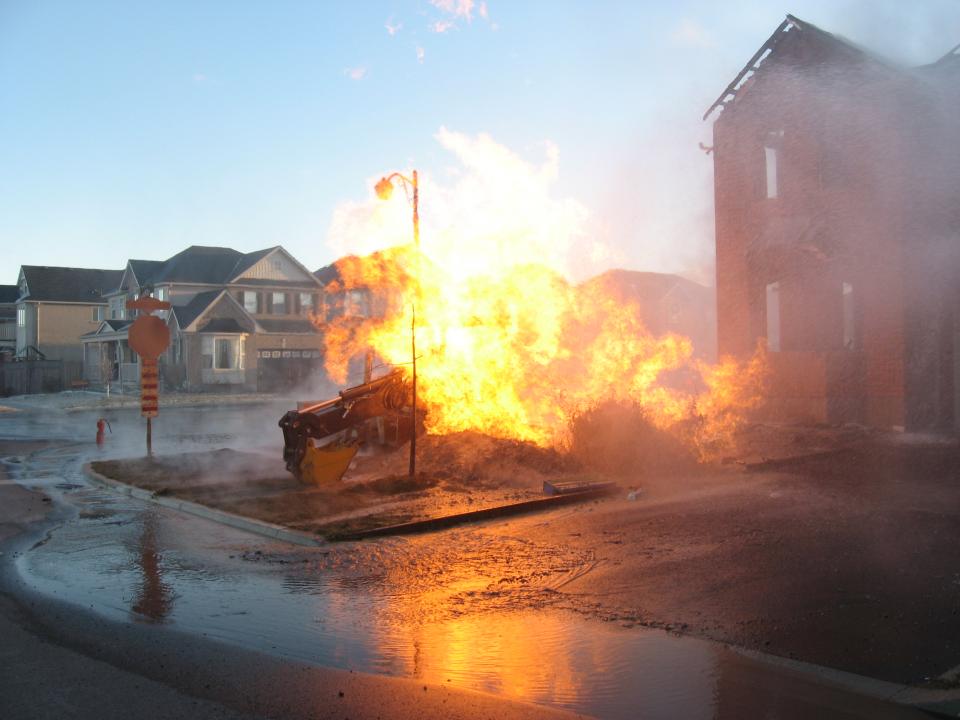
There was another story in the news recently highlighting the danger of unsafe excavation 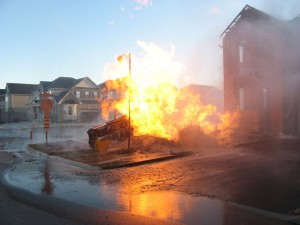 and the much needed changes with how to locate and dig around gas and utility lines. In Fresno County, CA, county workers were using a front end loader when a gas line was struck by the equipment, killing one man and injuring a dozen workers. It’s no question that if the line was properly located and a vacuum excavator was used to dig around the line then a life could have been spared. States and cities should require a vacuum excavator on all underground projects.
Vacuum excavation is defined as the process of using air or high pressure water to break apart soil and then debris is sucked up into the tanks. This method of excavation is commonly referred to as soft excavation technology and accepted as being much safer than traditional digging around underground facilities.
Vac-Tron Equipment has been the industry leader for vacuum excavation for over 20 years, innovating new ways of safer digging for companies globally. It is much less invasive in nature when compared to other traditional methods of excavating, has higher precision, and is leading to decreases in the amount of disposal of materials and accordingly much less surface restoration.
Vac-Tron’s equipment is made in the USA and distributed by over 40 nationwide dealers and 110 dealer outlets with new dealers being added internationally.
Vac-Tron recently announced 12 new innovations for vacuum excavation at the ICUEE show this year in Louisville, KY that will continue to keep the industry pushing ahead for safer digging. Here are a few highlights of new vacuum excavation innovations that were announced.
Vac-Tron HTV 573 PTO Truck: A NEW series of PTO truck driven systems available on Ford or Freightliner chassis. The full line of the HTV (Hydro Truck Vac) series has debris tanks ranging from 300 gallon to 1500 gallon in size. The Power Take Off of the truck drives positive displacement vacuum blowers that produce 1,000 to 3,000 CFM. These units are standard with a high pressure water system, full hydraulic rear door, reverse pressure, and the patented “Big Red” filter housing that cleans the air down to 0.5 microns (best in the industry) before it passes back through the vacuum pump. Air compressors and Hydraulic booms are also available on most of the HTV series units. Patent Pending.
Vac-Tron MT Series (Mud Trucks): New Series with 6 debris tanks sizes of 1500, 2000, 2500, 3000, 3500 and 4000 gallons. Over 45 degree hydraulic tilt, full open hydraulic locking door, PTO powered rotary vane vacuum pump, 25 inches of mercury, and reverse pressure, your chassis or ours. Great for cleaning up drill mud slurry.
A Wobble Head PROTOTYPE which is an innovative digging tool. Use a 6” hose head to dig a 24” hold by swiveling the end of the hose. Patent Pending.
For more information about safer digging with vacuum excavation, contact Vac-Tron Equipment at 888-822-8766 or visit vactron.com.
Uncategorized
 Submitted by
Project Scope
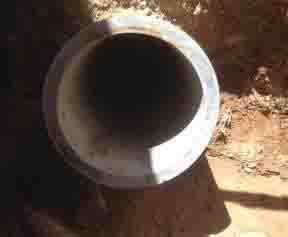
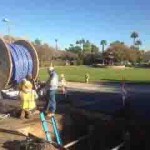
• Rehabilitation of 440LF of 12‐inch Asbestos Cement Pipe (ACP)
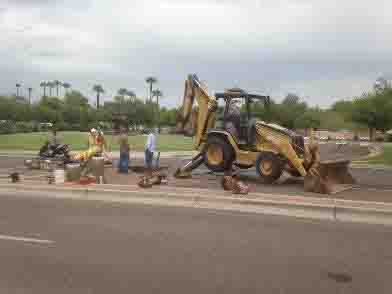
• Heavy traffic and utility corridor
• Pipe depth of up to 35 feet due to pedestrian tunnel above pipe
• Multiple bends up to 45‐degrees
• Impossible to open cut/ remove & replace
• Jack and bore was priced out – Primus Line reduced budget by 60%
Material Selection
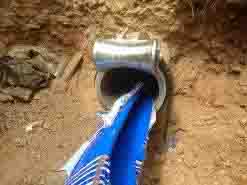
• Primus Line – Polyethylene lined and coated Kevlar
– 3 design / pressure ratings
 – 6‐inch to 20‐inch pipelines with at least 15psi
– Both potable and nonpotable systems
Construction Details
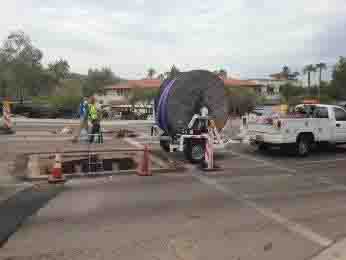
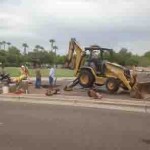
• Portals installed in turn lanes and center dividers
• Portals were 12’ x 8’ (2 total)
• Traffic was maintained through busy roundabout
Pipeline Preparation
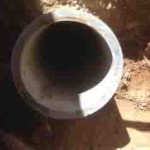
• Sharp edges must be removed prior to liner installation
• ACP did not require any surface preparation
• Cast iron bends had severe tuberculation
– Vactor pressure nozzle used for initial preparation
 – Soft pipe pigs pulled through
Liner Installation
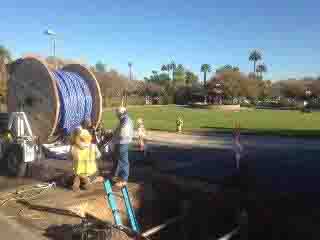
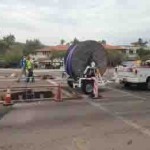
• Liner is folded and taped at factory and shipped on cable reel
• 10k ton wench used to pull liner
• 30 minutes of pulling, only 2k ton of force needed
• 15psi of air pressure to break tape loose inside pipe
• No bonding to host pipe
Termination of Liner
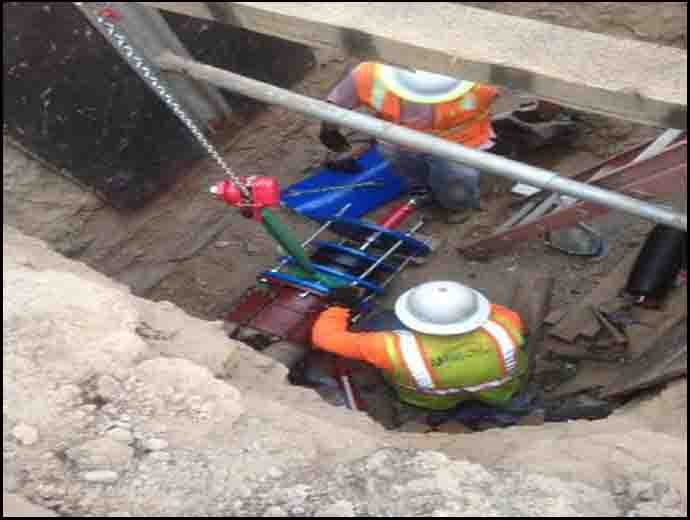
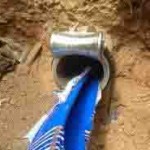
• Epoxy coated carbon steel or stainless steel flanged fittings
• Connects to host pipe with flanged coupling adaptor
• Primus Line flanged fitting is a compression fitting on liner
 • 3 hours to install fittings at each portal location
Startup and Testing
• 200psi pressure test for 2 hours
• Disinfected using slug chlorine method
• Both passed on initial tests
Project Summary
• Installation of 440lf of 12‐inch Primus Line
• Rehabilitation of potable water pressure pipe with 200psi rating and 5 bends in host pipe alignment
• Project completed for 60% less than dig and replace (w/ jack and bore)
• Installation by J. Wise Construction using JOC contract
Please call or e‐mail for additional
 information, pricing, or ideas
Chris MacDonald
480‐206‐2309
chris@constructionproductmarketing.com
Mike Ambroziak
602‐228‐5040
Uncategorized
Campaign Exceeded Goal by More Than $5 Million
WASHINGTON, D.C.(Feb. 4, 2016) – The Land Trust Alliance, a national land conservation organization working to save the places people love by strengthening land conservation across America, today announced the completion of its first campaign, which raised $40.1 million in new funds. The total is more than $5 million above the campaign goal.
“It’s of course a wonderful thing to celebrate the fact that we overshot our goal by over $5 million,” said Frederic Rich, campaign co-chair and vice chair of the Alliance’s board of directors. “Forty million dollars is an impressive achievement for an organization of this size. But frankly, it’s not the money that matters. It’s what we were able to do with this money.”
Used to increase the pace, improve the quality and ensure the permanence of land conservation, campaign funds were reinvested as they were received across five years. The resulting initiatives – such as making permanent a federal tax incentive for land conservation and establishing the Terrafirma Risk Retention Group – have transformed the entire land trust community.
“The title of this campaign was Together: A Campaign for the Land,” Rich said. “The Alliance itself is all about having the nation’s 1,700 land trusts think of themselves as together in a single, national movement. Every land trust itself is all about a community coming together to save the places that define them. And those places that we save, those are places where people come together and where their differences seem trivial. So if you ask me how we succeeded in this campaign, the answer is absolutely the same: We succeeded because we did it together.”
Leaders of land trusts across the United States already appreciate the differences the campaign has made. Nicole Byrd, executive director of Solano Land Trust in California, said the Alliance “invests in all of us and they are genuinely invested in our success.” And Christine Johnson, president of the Conservation Foundation of the Gulf Coast in Florida, described the Alliance as her “go-to place for making sure that I am doing all that I can to save the land we cherish so much.”
For more information about how the Alliance is helping land trusts save the places people need and love, visit www.landtrustalliance.org.
Campaign leaders included: David H. Anderson, honorary chair; Michael P. Dowling, campaign co-chair; and Frederic C. Rich, campaign co-chair. The campaign cabinet included: Robert A. Ayres; Alan M. Bell; Lauren B. Dachs, campaign vice-chair; Peter O. Hausmann, chair of the National Council; Sherry F. Huber, campaign vice-chair of regional committees; Ted Ladd, campaign vice-chair; and William Mulligan.
Regional campaign committees included chair Ted Ladd, Lisa Cashdan, Scott Dickerson, Jameson S. French, Sherry F. Huber, Laura A. Johnson, Mary McFadden, J.D., Nicholas J. Moore, Julie Sharpe, Steve Small and Peter Stein for the New England region; co-chairs Peter O. Hausmann and Frederic C. Rich, Christopher E. Buck, Marjorie L. Hart, Alice E. Hausmann, Tony Kiser, Fernando Lloveras San Miguel, Caroline P. Niemczyk and Michael A. Polemis for the New York/Mid-Atlantic/Puerto Rico region; co-chairs Alan M. Bell and William Mulligan, David Hartwell, Kathy K. Leavenworth and Judith Stockdale for the Midwest region; chair Lauren B. Dachs, Maria Elena Campisteguy, Anne Kroeker, Glenn Lamb, Richard Leeds, Thomas S. Reeve and Darrell Wood for the Pacific region; and co-chairs David H. Anderson and Robert A. Ayres, Lise H. Aangeenbrug, Laurie Andrews, Michael P. Dowling, Lawrence R. Kueter, Penelope H. Lewis and George S. Olsen for the Rocky Mountain/Texas region.
About the Land Trust Alliance
Founded in 1982, the Land Trust Alliance is a national land conservation organization that works to save the places people love by strengthening land conservation across America. The Alliance represents more than 1,100 member land trusts supported by more than 100,000 volunteers and 5 million members nationwide. The Alliance is based in Washington, D.C. and operates several regional offices. More information about the Alliance is available at www.landtrustalliance.org.

 collapsed in Old Croton Aqueduct State Historic Park, sending mud and debris up against a senior housing complex. The 150 year old wall appears to have given way due to saturated ground conditions caused by a leaking water pipe, recent heavy rains, and melting snowpack resulting from higher temperatures. The collapse sent a wall of debris 24 feet (7 m) wide down an embankment and deposited 4 to 6 feet (1.2 – 1.8 m) of mud up against the housing complex. The mud and debris blocked access doors to the building and caused possible structural damage resulting in the dislocation of approximately 110 residents. Luckily, no injuries were reported.