Industry News
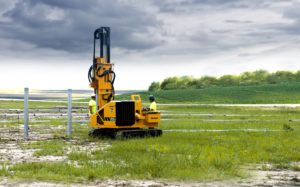 PELLA, Iowa, Oct. 15, 2019 — Vermeer is expanding its pile driver product line with the introduction of two new models. The Vermeer PD5 and PD5R pile drivers combine efficient operation and accuracy into a compact, lightweight machine well suited for working on smaller solar installation projects, congested jobsites and civil fencing and guardrail installation applications.
With a 15 foot (4.6 m) mast that can remain fully assembled when transporting and aided by a 90° rotating platform, the design of the PD5 and PD5R can help ease the setup and teardown process. With transportation weights of 10,350 pounds (4694.7 kg) for the PD5 and 10,300 pounds (4672 kg) for the PD5R, multiple units can be transported on a single trailer.
The PD5 features machine-integrated controls located on the side of the machine. The PD5R features a full-function wireless remote control that can engage the hammer, accurately align the pile to complete verticality using the auto plumb feature and position the machine. Both machines can use an optional laser receiver or a compatible third-party GPS system to help improve productivity by better aligning the machine to the specified pile install location.
“The solar industry has experienced tremendous growth in the last few years, and the Vermeer PD10 and PD10R pile drivers have been among the most widespread machines used for installing ground mount solar piles,” explains Ed Savage, product manager at Vermeer. “Of course, not every jobsite is the same, so we created the new PD5R and PD5 pile drivers to give contractors smaller and more lightweight options. These units include many of the same features as the PD10 and have similar productivity in a variety of soil conditions.”
Both pile drivers are powered by a Cat 49 horsepower (36.5 kW) Tier 4 Final diesel engine, have a forward travel speed of 2.6 miles per hour (4.18 km/h) so operators can move quickly from pile to pile and feature a mast pull-down that is rigidly attached to the mast chain to deliver powerful force.
Both machines will be available early 2020.
For more information about the Vermeer PD5 and PD5R pile drivers, visit Vermeer.com or contact your local Vermeer dealer.
Industry News, trenchless projects
The following is a post from Akkerman. For more details and additional job site photos, visit their website.
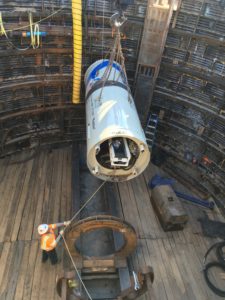 BRH-Garver Construction LP, a Houston based civil construction contractor pipe jacked 885-linear feet of 66-inch ID Permalok® casing filled with 48-inch carrier lines to convey treated water from the Canal Water Treatment Plant (WTP) for El Paso Water in El Paso, TX. The project risks and rewards existed in equal measure for all stakeholders.
The Canal WTP, also known as the Robertson Umbenhauer, was constructed 75-years ago and is situated between the Rio Grande River and a 100-year old BNSF rail yard. The new transmission lines culminate to tie in at San Antonio Avenue in downtown El Paso.
The water lines on the Canal Water Treatment Plant Discharge Main Tunnel project traveled under Highway I-85, and 18 BNSF rail yard tracks in soft ground conditions presenting many opportunities for settlement. El Paso’s water table is prone to seasonal variability due to its proximity to the river, and the likelihood of contaminated ground, existing utilities and obstructions in the 100-year old rail yard posed a potential threat to tunneling personnel and loss of production. Since the launch shaft was in an active BNSF rail yard, frequent and diligent communication and coordination with the railroad personnel transpired for safety, and equipment and material staging.
Several factors contributed to project cost savings including the use of a more cost-effective Tunnel Boring Machine (TBM) system over a microtunneling system, a value-engineered design to initiate both bores from one launch shaft inside the rail yard to emerge into one reception shaft, the downsizing of casing diameter from 72 to 66-inch, and the avoidance of deep well dewatering, which also reduced settlement risk.
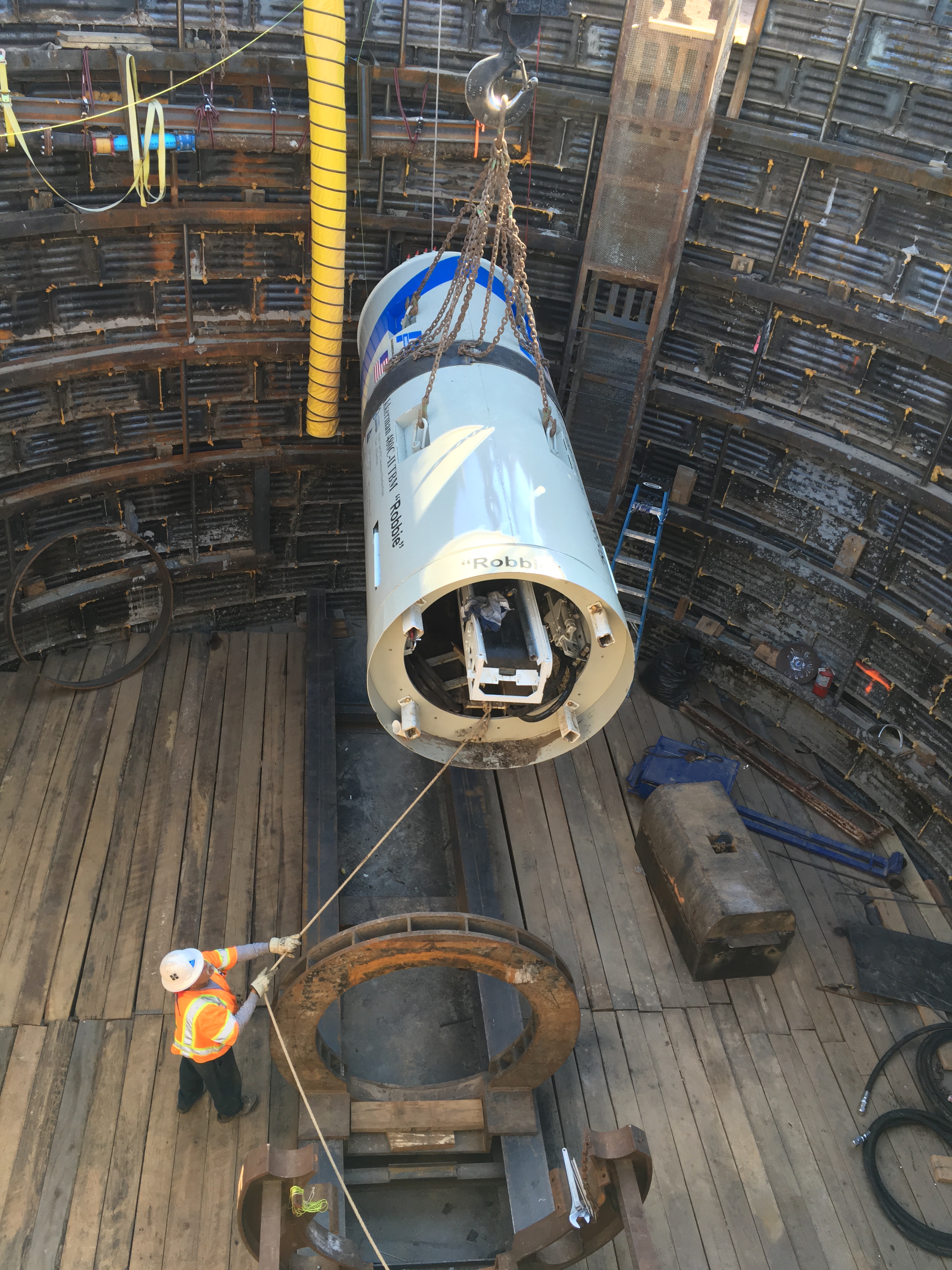
The contractor’s pipe jacking experience informed the resolution of the project’s more difficult challenges when completing the 570- and 315-linear foot tunnels. When unforeseen cobbles were discovered, the hydraulic doors on the TBM cutter head provided passage for the cobbles with minimal loss of production. When unpredicted boulders were discovered, although (continued)tunneling had to pause to allow chemical grout to be used to stabilize the bore, the hydraulic doors provided essential access for breaking the boulders to a size that allowed for their passage to successfully complete the tunnel. When the crew ran into unanticipated PPCA ground conditions, the crew persevered by using a full-face mask filtration system to resume mining operations.
The project was deemed successful, and the TBM named “Robbie” in honor of the 75th anniversary of the Robertson Umbenhauer WTP, proved to be the right method.
- Breff Cooling of BRH Garver, comments on the equipment selection, “The versatility of the Akkerman TBM with hydraulically-operated doors, gave us some options that a MTBM would not have. A slurry machine may have been the preferred choice under critically located structures in ground that varies from clay, to sand seams, to running gravels. However, the small but real possibility of boulders, or steel fish plates and other obstructing debris sometimes found under rail yards, tipped the balance towards selecting a manned-entry TBM for accessing any obstructions. With the benefit of hindsight, we can say that the TBM turned out to be the better choice in this case because we ended up discovering unforeseen boulders.”
Cooling also credits the railway stating, “We are grateful for the exceptional cooperation from BNSF for accommodating our field operations inside their busy 24-hour around-the-clock rail yard operations.”
The Canal Water Treatment Plant Discharge Main Tunnel project was designed by a partnership between CDM Smith and Parkhill, Smith & Cooper who also provided site supervision and contract administration. Tunneling technical support, oversight and settlement monitoring was performed by Killduff Underground Engineering.
Cooling concludes, “This is the third time BRH-Garver has partnered with an engineering firm for a design-build project, and the first for time for a tunneling project. The partnership accepted transfer of nearly all risk for the client and proved very effective for BRH to apply three decades of tunneling experience towards the optimum tunneling solution for the design changes. Our preference would be for this type of project delivery all of the time.”
Industry News, trenchless people
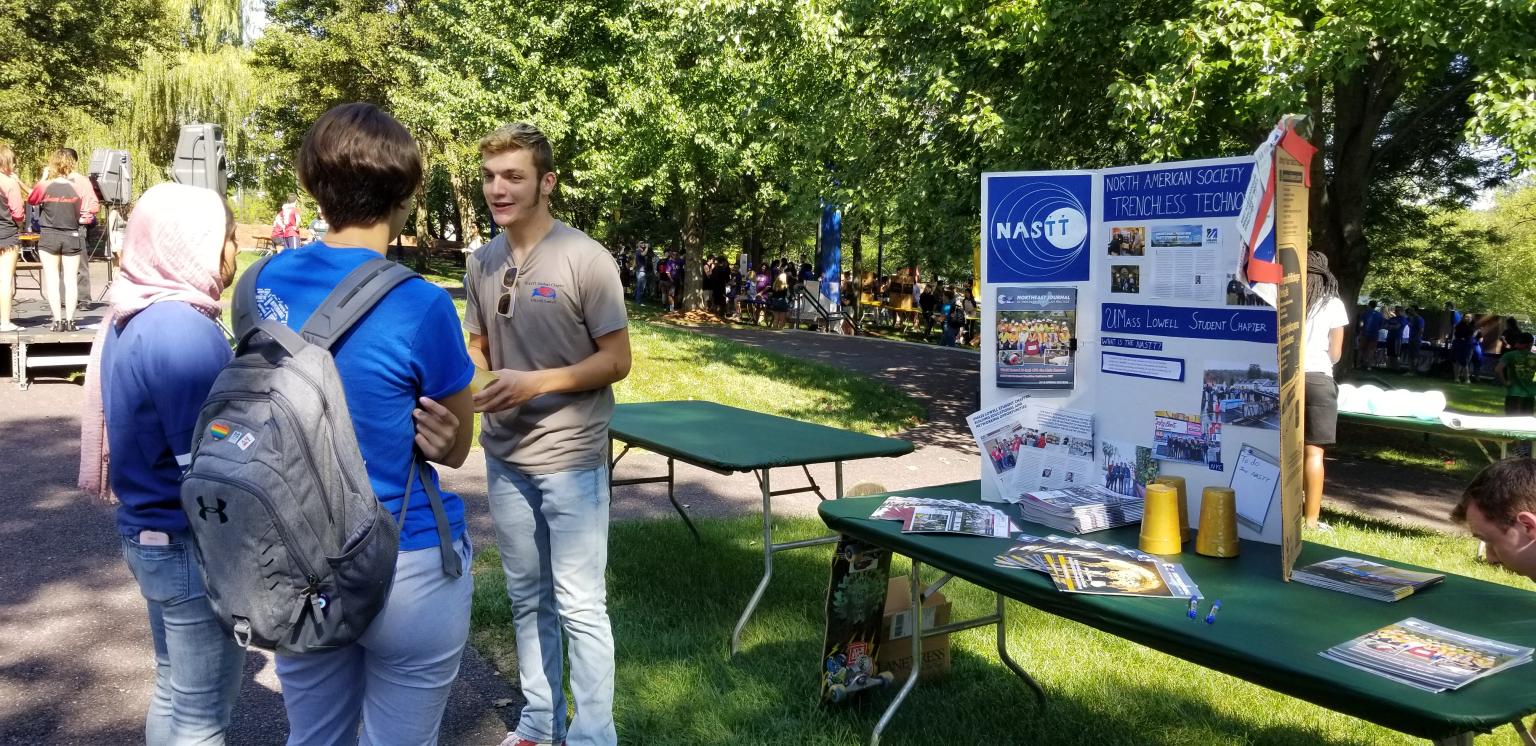
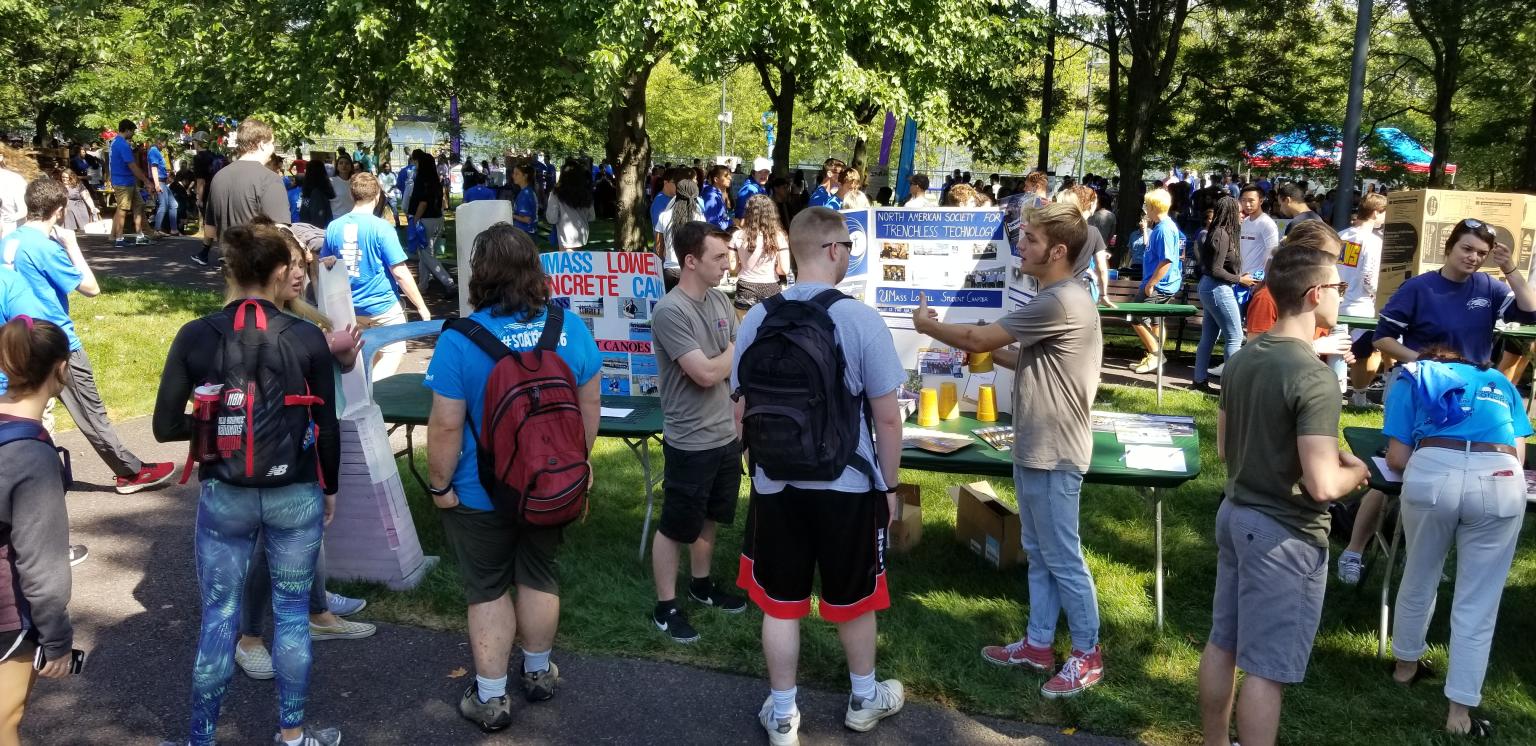
 Recently the NASTT Student Chapter at UMASS Lowell participated in the school’s annual campus club recruiting event. They had a table at the event outlining what the student chapter does and why trenchless matters. These students are passionate about growing interest in the trenchless industry!
NASTT volunteer instructor and “Trenchless Guru” (yep, that’s his X handle!), Dennis Doherty, is very involved with the students at UMASS Lowell and volunteers his time to mentor these future trenchless champions. Dennis is the National Practice Leader of Trenchless Technologies at Haley & Aldrich. Dennis said, “Get involved with our students. They are our future”. We couldn’t agree more!

Industry News, trenchless people, trenchless projects
When contractors provide estimates that include a sewer bypass, accuracy is essential—each project is unique, and accounting for these nuances is critical to maintaining margins. Failure to plan on the front end may lead to an influx of change orders and a big hit to the bottom line. Damages could go further than money alone: An estimating mistake might lead to a sanitary sewer overflow (SSO). Following an SSO, you can expect large sums for cleanup and DEQ penalties, along with negative PR and a ripple effect that could impact future projects.
Before submitting a bid, it’s critical to cover all the bases and avert potential problems on the job. The following lessons learned can help contractors avoid estimating mistakes, win bids, and complete projects at a profit—and without visits from the DEQ.
Lesson 1: Take a bottom-up approach to estimating.
Often estimators have little choice but to use unit costs, like cost per foot of pipe, for an estimate. But that doesn’t eliminate the need to check the latest prices. Inserting the cost from the last project without checking it seldom produces a safe number. Even if a job appears to be the same size and complexity as a previous project, treat every job individually and get a current price for every item.
Lesson 2: Always visit the project site with a knowledgeable individual.
Unforeseen site conditions are the largest contributor to project change orders and increased costs. Plans and drawings alone do not provide the information needed to route pipe, situate pumps, and manage flow for a sewer bypass. Avoiding this mistake is easy: Always visit the site with the engineer or a representative from the municipality—whoever has the most in-depth knowledge of the project. The sewer bypass subcontractor should also attend to explain the capabilities, as well as the limitations, of the pumping system. Consulting with the entire team will help ensure a solid quote for that portion of the contract.
Lesson 3: Insist on backup detail for subcontractor quotes.
Contracting firms often use subcontractors to design a sewer bypass for a larger project. Even if the subcontractor has complete confidence in the system as designed, never take their word that it will handle the sewer bypass flow for the cost they plan to charge. Instead, request the engineering calculations and system drawings, and then ask the design engineer to review them. Based on the information the subcontractor provides, the scope of equipment, system layout, and performance should be clear.
Lesson 4: Do due diligence on labor costs.
Labor costs often comprise the largest portion of a sewer bypass budget. Costs for prevailing wage and certified payroll add up quickly. Different project conditions can impact labor costs significantly, even for the same task. For example, a team working on a city street with heavy traffic may install less bypass piping each day than one working in an open field. Therefore, it’s critical to examine labor costs in detail over the project timeline, including hours and types of labor for each task. Then, make sure your bypass subcontractor offers a firm commitment on the cost.
Lesson 5: Factor in risk and the potential for lost revenue when accepting a low bid.
Although selecting the subcontractor with the lowest bid can be tempting, ultimately the project may cost more. Never assume a subcontractor will take responsibility for problems that result from lack of experience or expertise. Instead, consider all the worst-case scenarios that could occur, such as a sanitary sewer overflow. Ensure the subcontractor can manage each and every problem that may arise. Double check contract limitations and exclusions, the safety plan, and the spill and emergency response plan. In addition to liability considerations, it’s critical to review a bypass subcontractor’s bid to ensure it is complete. Have they included enough in labor costs to complete the project? Are fuel costs included, or even tax? Low bids may leave out these important components which can result in lost profits.
Lesson 6: Review the engineering submittal with the subcontractor.
To ensure all the estimate information is correct, always review the engineering submittal against the specifications with the subcontractor to make sure it matches the information in the request for quote. As a best practice, the engineering submittal should include not only the information required within the specifications, but also all the pertinent details about the temporary pumping system. It should be clear and concise so anyone who reads it will fully understand how the system is designed, set up, and operated. It should also have all the supporting documentation such as fluid calculations, drawings, and specification sheets on the equipment being used.
Checking the engineering submittal against the specifications will help to reduce or eliminate the engineer sending the submittal back for changes. Until the submittal is approved, the job cannot go forward, so in order to keep the project on track, it’s important to cross-check the documents before sending to the engineer.
Lesson 7: Assume the cost quoted can never be modified.
Do not count on subcontractors to take responsibility for problems and resolve them in a timely manner. The contractor is ultimately on the line and will be held to the amount put in every box on every bid. To be competitive, a firm’s margins must remain as low as possible while still providing a profit. If a quote does not include every item down to the last fitting and bolt, the margin and profit will suffer. The bypass subcontractor and firm should work together to determine the right costs to put into the bid tabulation sheet. Also, to avoid being buried in unanticipated invoices, be certain to incorporate a billing schedule with the bypass subcontractor that indicates when invoices will be received and what they are for.
Abiding by these seven lessons learned should avert many potential problems that occur in sewer bypass and ensure a winning bid that leads to a profitable and successful project.
For more information, visit www.sunbeltrentals.com or call 800-736-2504.
Blog, Industry News, trenchless projects
Compact TBM bores longest Rock Tunnel at 2.46 m Diameter
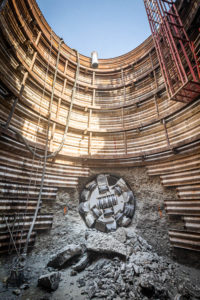 In August 2019, a small diameter Double Shield TBM made a big impact. The 2.46 m (8.07 ft) diameter Robbins machine completed 3,475 m (11,400 ft) of boring with no intermediate access, making it the longest rock tunnel ever bored by a Double Shield TBM under 2.5 m (8.2 ft) in diameter.
The machine completed the Parmer Lane Wastewater Interceptor in Austin, Texas, USA for contractor S.J. Louis Construction. Despite obstacles including two tight curves of 150 m (500 ft) radius and unexpected ground conditions that required modification of the cutterhead in the tunnel, advance rates were good. The machine reached up to 380 m (1,250 ft) per month while mining in single 12-hour shifts per day. “It was a hard rock TBM, and it performed better than expected through hard rock,” said Zach West, Project Manager for S.J. Louis.
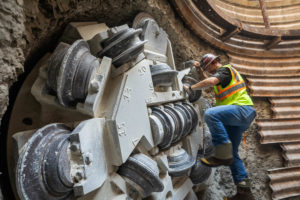
The challenges for the TBM and its crew were varied, explained West. “The pairing of this tunnel length, which is on the longer side, and the diameter, which is on the smaller side, is challenging. The survey in a small tunnel with tight radius curves and limited surface access for over two miles is very difficult.” He added that the shallow tunnel depth, and the alignment to within a few feet of sanitary lines, high-pressure gas mains, and fuel tanks for gas stations, made TBM guidance critical. “I would say that I am most proud of our ability to guide the machine successfully through these obstacles and into our retrieval shaft within our expected tolerances.”
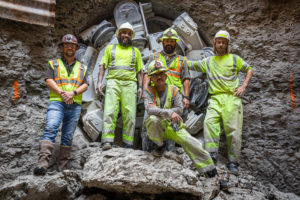 Through one stretch, the tunnel advanced directly between a 30 cm (12 in) diameter, high-pressure gas main and fuel tanks for a gas station with limited as-built information. “Navigating this section took a great deal of coordination with the local utility companies. Because the tunnel diameter was too small for an automated guidance system, we manually surveyed the front of the machine at every push to ensure the machine was on track,” said West.
“I’m proud that they mined the longest tunnel to date for a small shielded gripper machine of this size without any safety issues. Kudos to their management philosophy and jobsite team,” said Tom Fuerst, Robbins Utility Tunneling Sales Manager. Robbins assisted the crew while in the tight 150 m (500 ft) curves and helped with modifications required to the cutterhead and disc cutter arrangement.
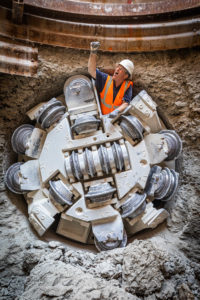 The tunnel is located in an environmentally sensitive aquifer, with ground conditions ranging from soft dolomite with clay to limestone from 13 to 68 MPa (2,000 to 10,000 psi) UCS. “While we tunneled through the softer material, our best advance rate was close to 0.9 m (3 ft) per hour. When we tunneled through the expected limestone, advance rates were over 5.2 m (17 ft) per hour. Our best day was 25 m (81 ft) in a single shift,” said West.
The majority of the tunnel used a simple two-rock-bolt pattern for support. In the last 10% of the tunnel, ribs and lagging were used as support. Final carrier pipe, which is now being installed, consists of 110 cm (42 in) diameter fiberglass pipe.
The successful project is part of a larger trend towards small diameter, TBM-driven rock tunnels in the United States, says Fuerst. “It is primarily due to demographics and business growth. The parts of the USA that are growing need to build out their sewer and water infrastructure. TBMs can mine long distances with tight curves. They can reduce the need for multiple shafts, which lowers the overall project cost. And, given that most small diameter pipelines follow a road or municipal right-of-way, traffic problems are reduced significantly compared with open cut operations.”
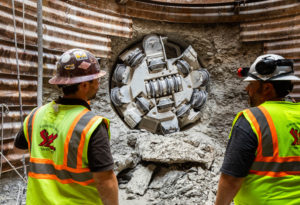 The Parmer Lane Wastewater Interceptor connects to two existing lift stations at Lake Creek and Rattan Creek. The tunnel allows for these lift stations to be decommissioned, and will provide additional flow capacity by gravity, reducing operating costs for the City of Austin.
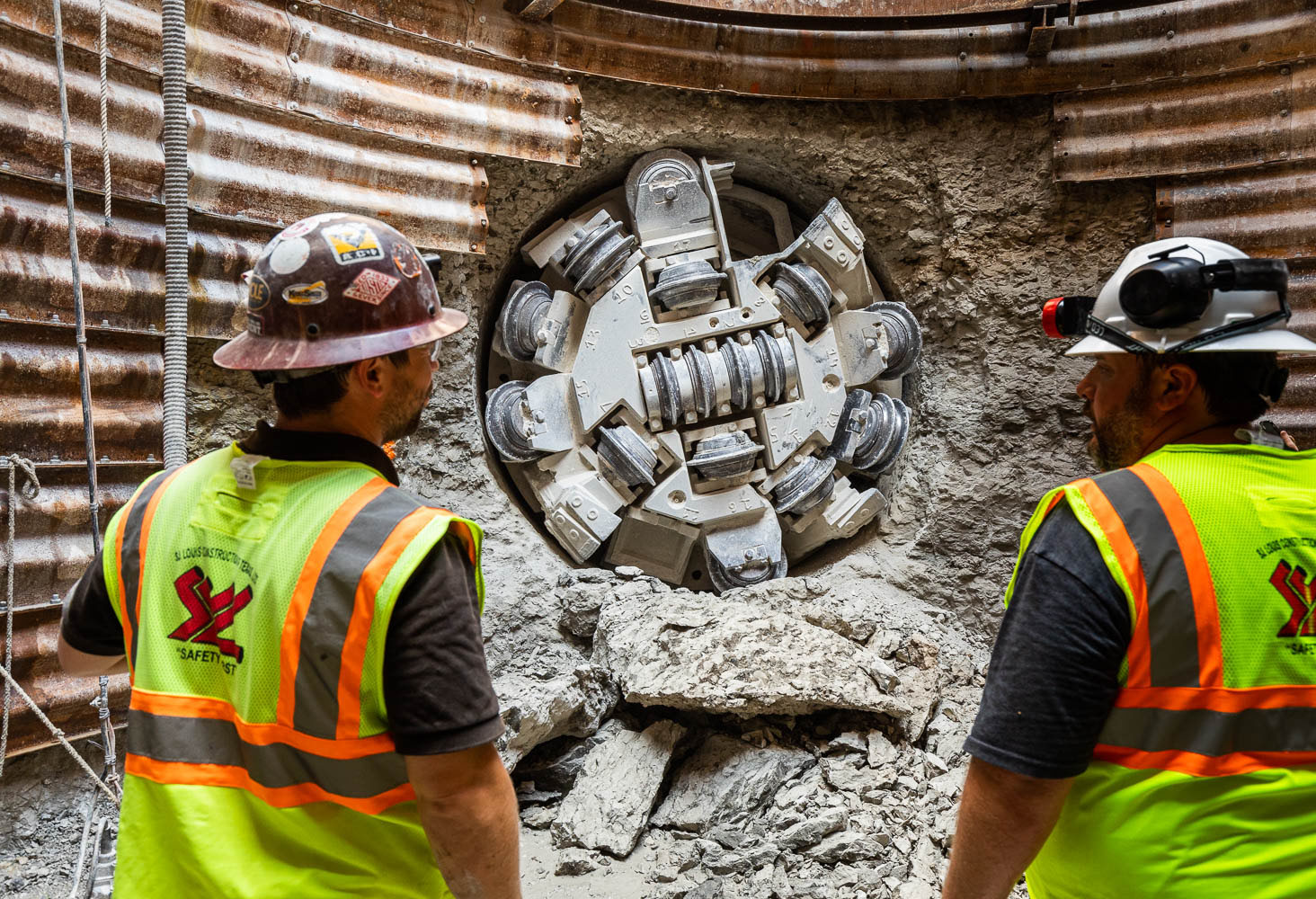
Image 1: Completed in August 2019 with a Robbins Double Shield TBM, the Parmer Lane Wastewater Interceptor will provide additional flow capacity via gravity in Austin, Texas, USA.
Image 2: The 3,475 m (11,400 ft) tunnel bored by a Robbins TBM is the longest ever bored by a Double Shield machine under 2.5 m (8.2 ft) in diameter.
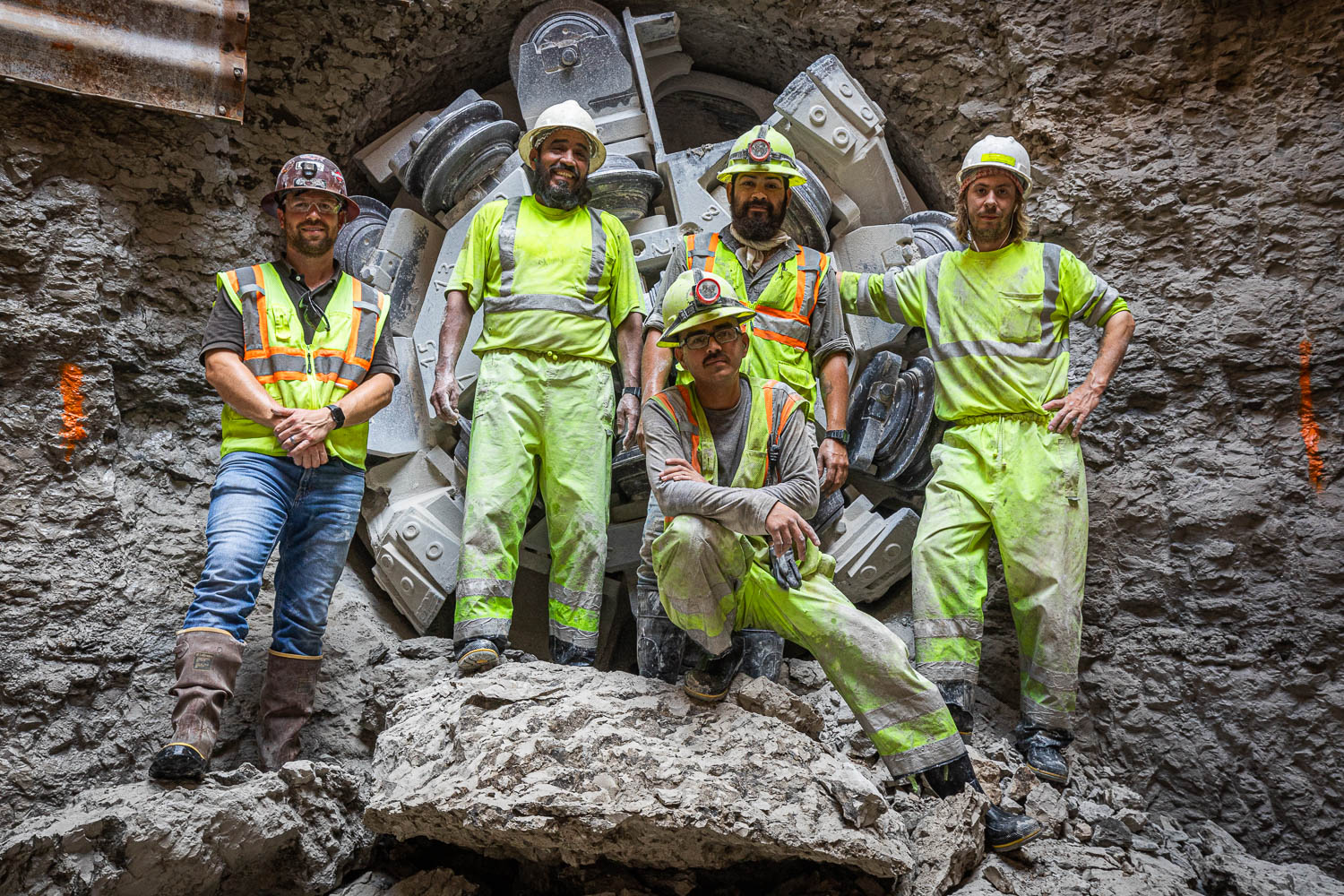
Image 3: The S.J. Louis Construction crew celebrate the successful and safe completion of the Parmer Lane Wastewater Interceptor with a Robbins TBM.
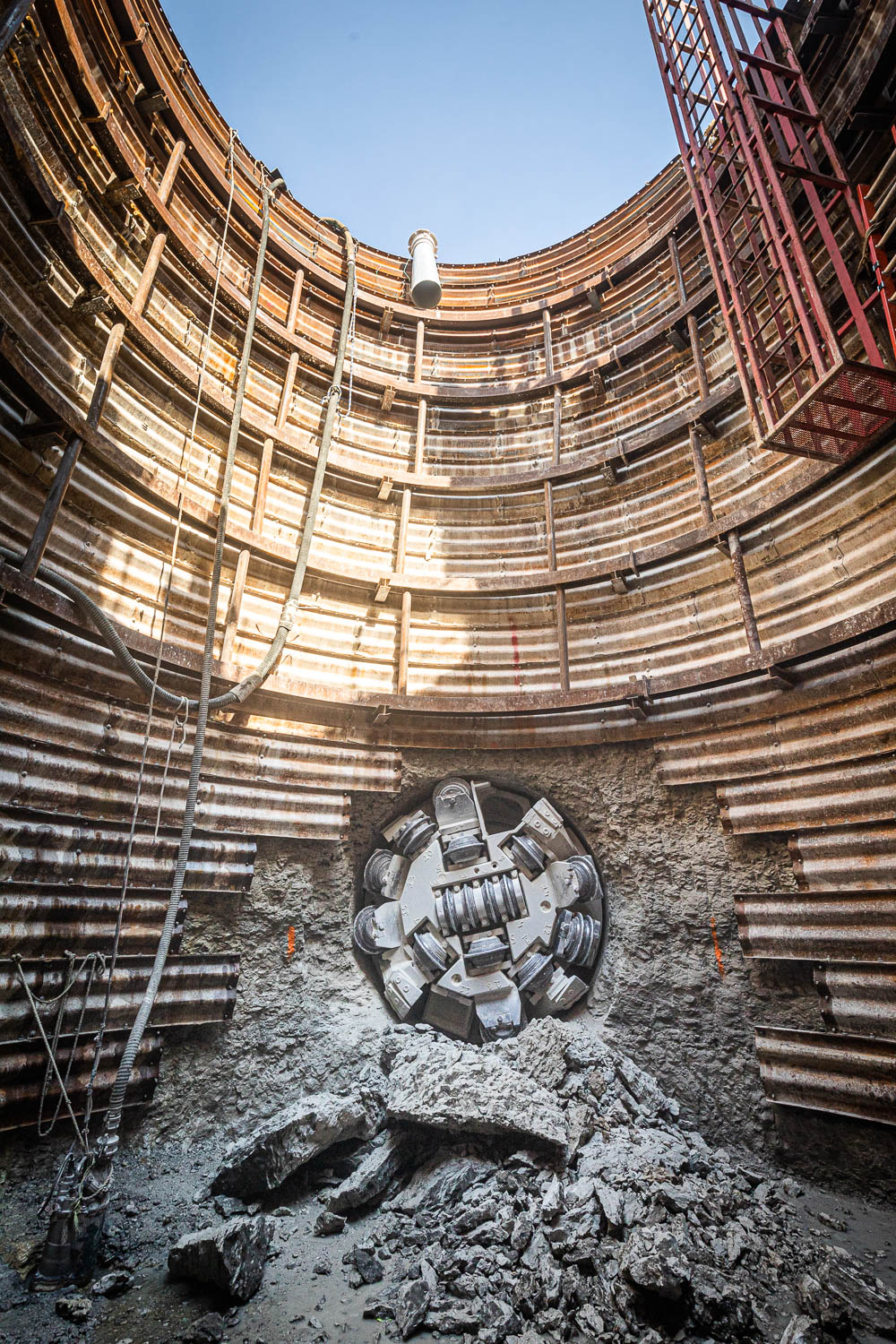
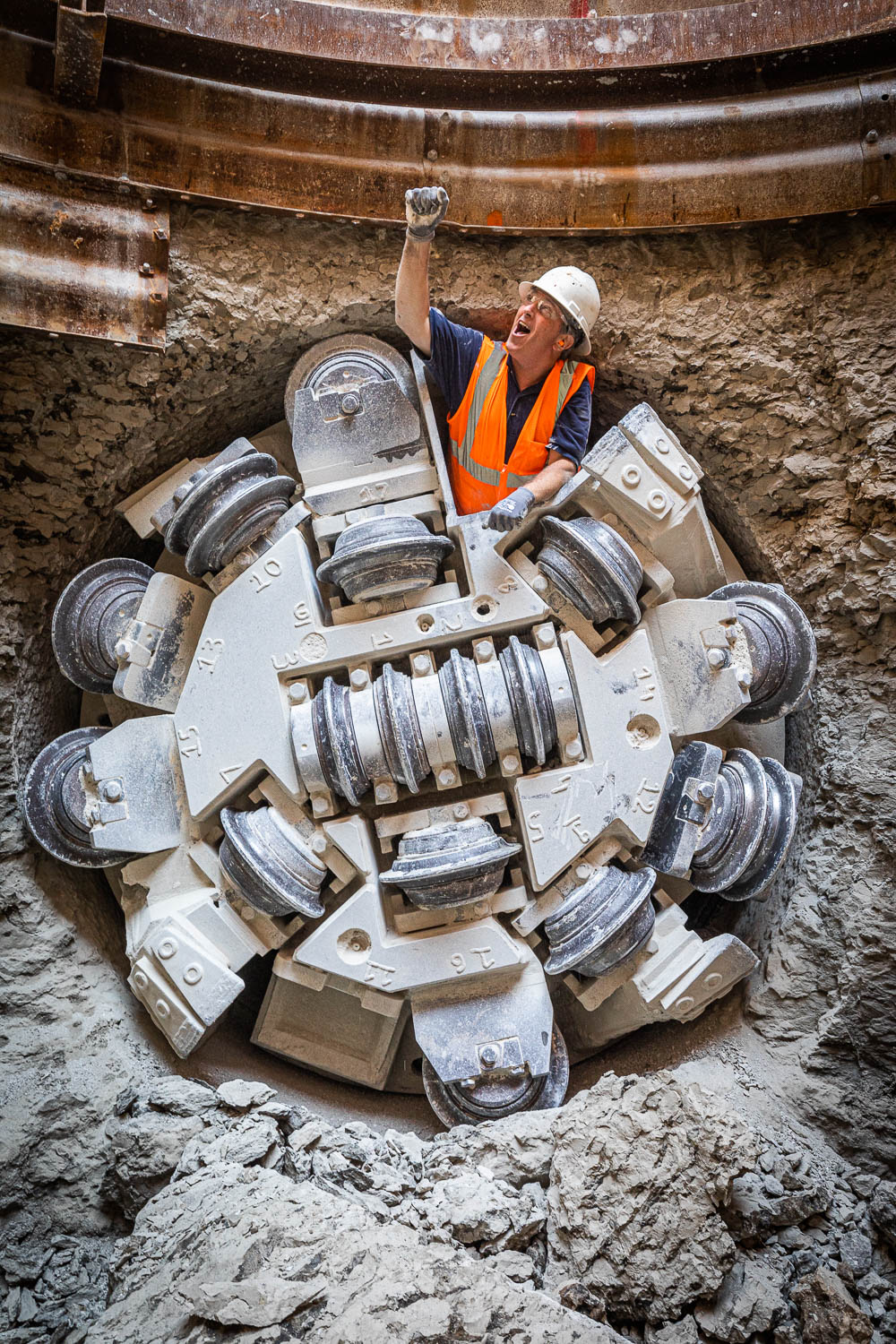
Image 4: Tom Fuerst, Robbins Utility Tunneling Sales Manager, celebrates as he exits the TBM during its August 2019 breakthrough in Austin, Texas, USA.
Image 5: The Robbins TBM bored through dolomite with clay and limestone at rates of up to 380 m (1,250 ft) in one month while mining in single 12-hour shifts per day.
Industry News, The No-Dig Show, trenchless people

 The North American Society for Trenchless Technology (NASTT) — the leading association serving and promoting the North American trenchless industry — is pleased to announce municipal and public utility scholarship opportunities to attend the NASTT 20202 No-Dig Show, April 5-9 in Denver, Colorado.
In 2013, NASTT established the No-Dig Show Municipal & Public Utility Scholarship Award Program to provide education and training for employees of North American municipalities, government agencies and utility owners who have limitedor no training funds due to economic challenges. In past years, over 100 applicants were awarded the scholarship annually.
“The NASTT Municipal & Public Utility Scholarship offers public agencies the opportunity in which to participate and experience the world of trenchless. Since its inception in 2013, scholarships have been awarded to more than 850 applicants, and the success of the program continues to increase every year.” said Joe Lane, 2020 No-Dig Show Program Chair and V.P. of International Operations for Insituform. “With an entire show dedicated to trenchless technology, this scholarship is a tremendous opportunity for municipal & public utility employees to attend at little or no cost.”
Selected scholarship winners will be awarded Full Conference and Exhibition registration to the NASTT 2020 No-Dig Show. Also available are one day conference registrations which include full access to all exhibits and technical paper sessions. Selected applicants will also be eligible to receive complimentary overnight accommodations for three nights at the host hotel. The scholarship applications are reviewed by a committee of NASTT volunteers and awarded based upon the supplied responses.
To apply for the scholarship, complete the application online at
nastt.org/no-dig-show/municipal-scholarships on or before November 1, 2019. Applicants are not required to be NASTT members.
NASTT’s Municipal & Public Utility Scholarships program is sponsored by Benjamin Media, Inc, award-winning publisher of the leading underground construction magazine, Trenchless Technology.
For more information about NASTT’s No-Dig Show visit www.nodigshow.com, email conferences@benjaminmedia.com or call 330-467-7588.
Industry News, trenchless people
 Zahra (Ellie) Kohankar Kouchesfehani is a Ph.D. Student and Graduate Research and Teaching Assistant at the Center for Underground Infrastructure Research and Education (CUIRE) in the Department of Civil Engineering at The University of Texas at Arlington. She is a NASTT Student Chapter Member and a valuable volunteer at our annual No-Dig Show.
We are excited that Zahra’s submission, “Structural Design Methodology for Spray Applied Pipe Liners in Gravity Storm Water Conveyance Conduits as a Trenchless Renewal Application,” has been selected for an ISTT 2019 No Dig Award.
The selection team found the methodology to be a significant contribution to the trenchless world.
The award will be recognized at the Gala Dinner and Awards Ceremony on October 1, 2019 at the 37th International No Dig Conference in Florence, Italy.
Congratulations, Zahra!
Industry News, trenchless products
Perfect for hard rock and fractured ground formations
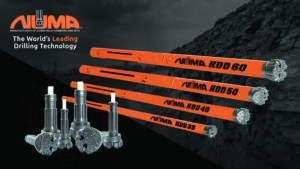 THOMPSON, CONNECTICUT USA, August, 2019:
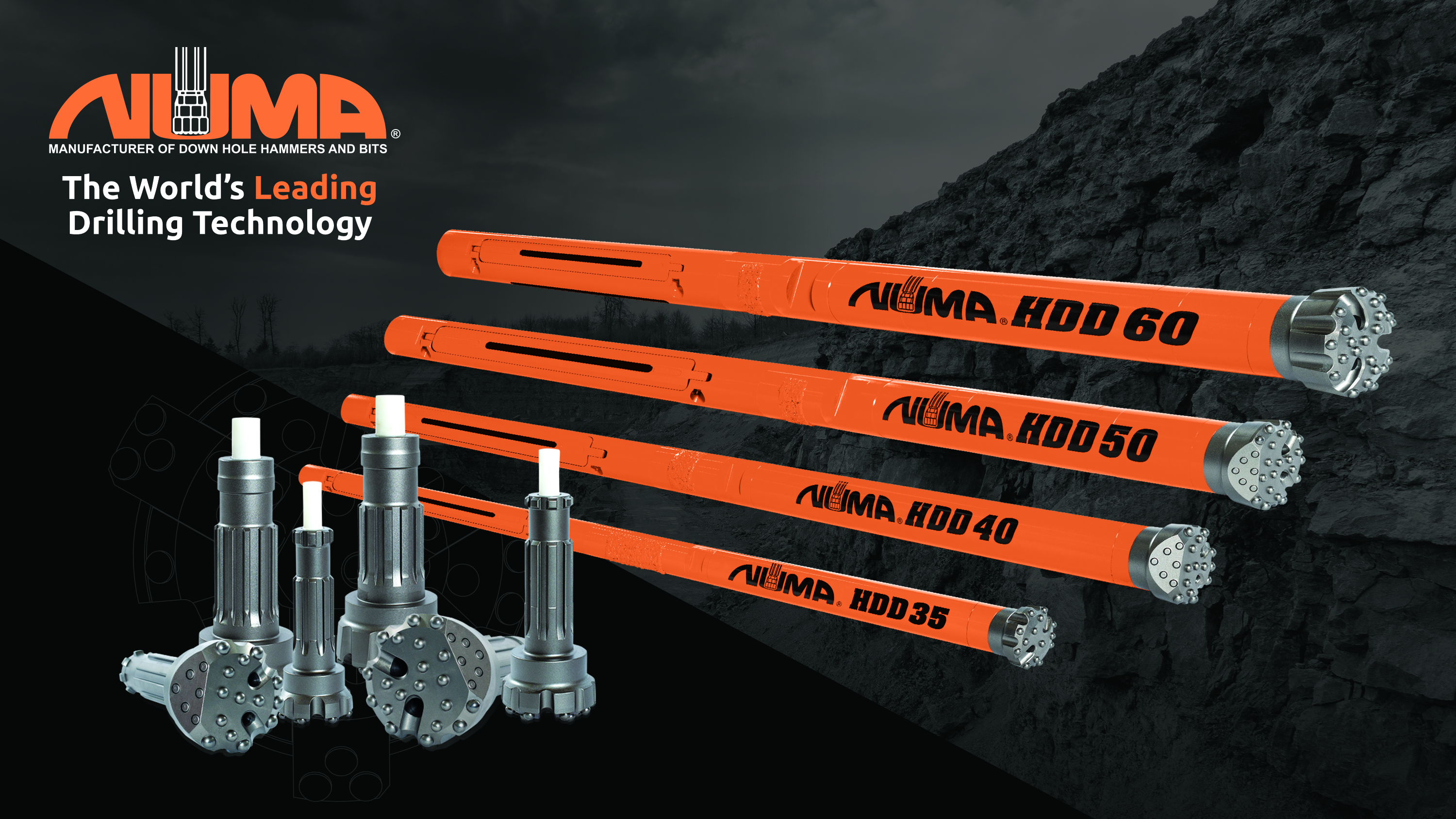
Numa, the world’s leading drilling technology provider, has released a range of HDD Drilling Systems designed for productive and efficient drilling in hard rock and fractured ground formations.
“Numa has a long history of serving the HDD market and with our range of HDD Drilling Systems we enhance our ability to serve our customers with the right products for the job,” said Numa President, Ralph Leonard. “Our high quality, Made in the USA HDD products provide the right balance of performance and dependability without sacrificing tool life.”
Numa’s HDD Drilling Systems consist of a variety of HDD components including hammers, bits, side load sonde housings, bent subs, and adaptors which are capable of drilling holes 4″ to 7-1/2″ (102 mm to 191 mm) in diameter. Some of the many benefits Numa touts for the HDD hammer line include: improved steerability, fast penetration rate, simplified field maintenance, reduced air requirements, and lower overall cost per foot.
With deep experience in rock drilling, Numa purposely designed their HDD hammers to drill longer in difficult rock conditions. Furthermore, a single bore design allows for a maximum bore diameter in conjunction with providing optimum life against abrasion. The full line of Numa’s HDD Drilling Systems is made up of the models indicated below with a full description on their website product page.
- HDD 35 for drilling holes 3-7/8” to 4” (98 mm – 102 mm) in diameter
- HDD 40 for drilling holes 4-3/4” to 5” (121 mm – 127 mm) in diameter
- HDD 50 for drilling holes 5-3/4” to 6-1/8” (146 mm – 156 mm) in diameter
- HDD 60 for drilling holes 7″ to 7-1/2″ (178 mm – 191 mm) in diameter
Numa will be featuring their HDD Drilling Systems in booth #1905 at the ICUEE 2019 show happening October 1-3 in Louisville, Kentucky.
ABOUT NUMA
Numa is the world’s leading drilling technology provider, dedicated to ongoing product innovation and results-oriented consistency. We’ve built a strong legacy of high quality, U.S. made hammers and bits for drilling holes 3½ – 50½ inches (89 -1283 mm) in diameter. With over 100 hammer and bit products serving 11 different industries, our products are capable of drilling vertical, horizontal, and reverse circulation holes in hard rock and unconsolidated formations.
Industry News, trenchless people
 Longtime underground construction and trenchless industry professional Davis Yates passed away Tuesday, July 2, 2019 at the age of 51. Through his career Yates worked at trenchless equipment manufacturer TT Technologies, Aurora, Ill., Mocon Corp., Southern California HDPE pipe, fitting and fusion supplier Maskell-Robbins, as well as a variety trenchless and underground contractors along the West Coast.
Yates trained many people throughout his career in the proper use of various boring, tools, pipe rammers and pipe bursting systems. He was an energetic and innovative individual whose way of getting the job done was very much appreciated by those he worked with over the years.
Always an innovator, always creative and always seeing the job through, he became great friends with many of the people he worked with in the field and will be missed by many.
Yates leaves behind two children, Jenna, 13 and Marcus, 11. A Go Fund Me page has been established to help with the expenses of his children’s future education, as well as the planting of a remembrance tree. Donations will be placed into a savings plan for both Jenna and Marcus.
The Go Fund Me Page can be found here: https://www.gofundme.com/f/jenna-and-marcus-dad
Industry News, trenchless people
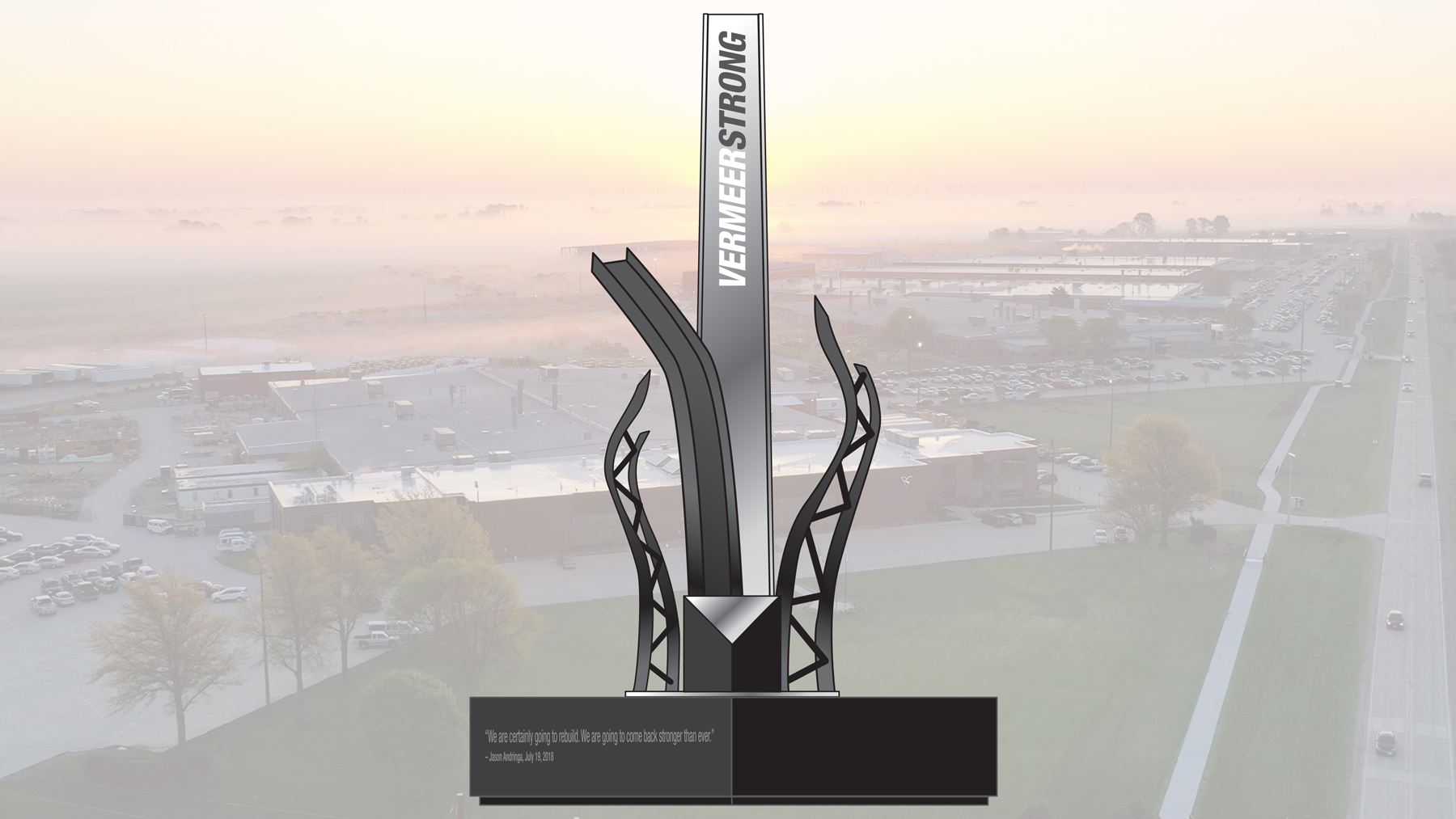
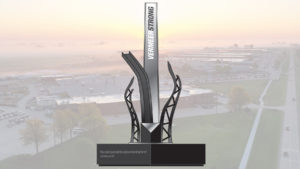 PELLA, IA – Recently, Vermeer Corporation held the groundbreaking for a monument commemorating the buildings destroyed by an EF3 tornado last July (2018), while celebrating the strength of the Vermeer team and the growth and progress that is happening along the Vermeer Mile.
“The tornado was the greatest challenge Vermeer has ever faced. I am incredibly proud to say our team has turned it into an opportunity. Not only are we rebuilding what we had, but we’re becoming stronger than ever before,” said President and CEO Jason Andringa.
With three new facilities underway at the Pella-based headquarters, Vermeer is investing heavily in the future.
The first facility scheduled to open this summer is a new engineering and R&D building named Shop 48. The name stems from Founder Gary Vermeer’s shop where his innovations came to life and led to the founding of Vermeer Corporation in 1948. With more than 100,000 square feet of space dedicated to building and testing new equipment, team members will begin to move into this space in August.
“We’re very fortunate at Vermeer to have a 71-year history of innovation. Shop 48 will take our innovation and growth opportunities long into the future,” said President of Industrial Solutions Doug Hundt.
Plant 7 was formally announced as the new facility being built where Plants 5 & 6 once stood. Nearly 500,000 square feet of manufacturing and office space will expand beyond the original manufacturing footprint that took up just less than 400,000 square feet of this area. The new facility will connect to the original Plant 7 that was damaged in the tornado but repaired in the months following. Together, they will take on the name Plant 7. Scheduled to be completed in fall 2020, this facility is being built to keep team members safe at every touchpoint on the job, create ultimate productivity, be a collaborative and engaging space for team members and allow for growth long into the future. Incorporating advanced manufacturing techniques and continuous improvement best practices will help drive world-class manufacturing. “Looking ahead, this facility is going to be world-class in every feature. We’re advancing our paint technology, coat technology and the space for our team,” said Vice President of Operations Bill Blackorby.
Also recognized was the new Eco Center. Replacing the one lost in the tornado, the new building will be placed behind Plant 1 and open its doors in January 2020. The Eco-Center helps responsibly process and manage waste along the Mile.
“Our customers depend on our ability to get high-quality equipment to them – this new facility makes us excited to continue to deliver on this promise into the future,” said Executive Vice President of Forage and Lifecycle and Chief Marketing Officer Mark Core.
About Vermeer Corporation
Vermeer delivers a real impact in a progressing world through the manufacture of high-quality agricultural, underground construction, surface mining, tree care and environmental equipment. With a reputation for durability and reliability, that equipment is backed by localized customer service and support provided by independent dealers around the world. To learn more about Vermeer, products, the dealer network and financing options, visit Vermeer.com.

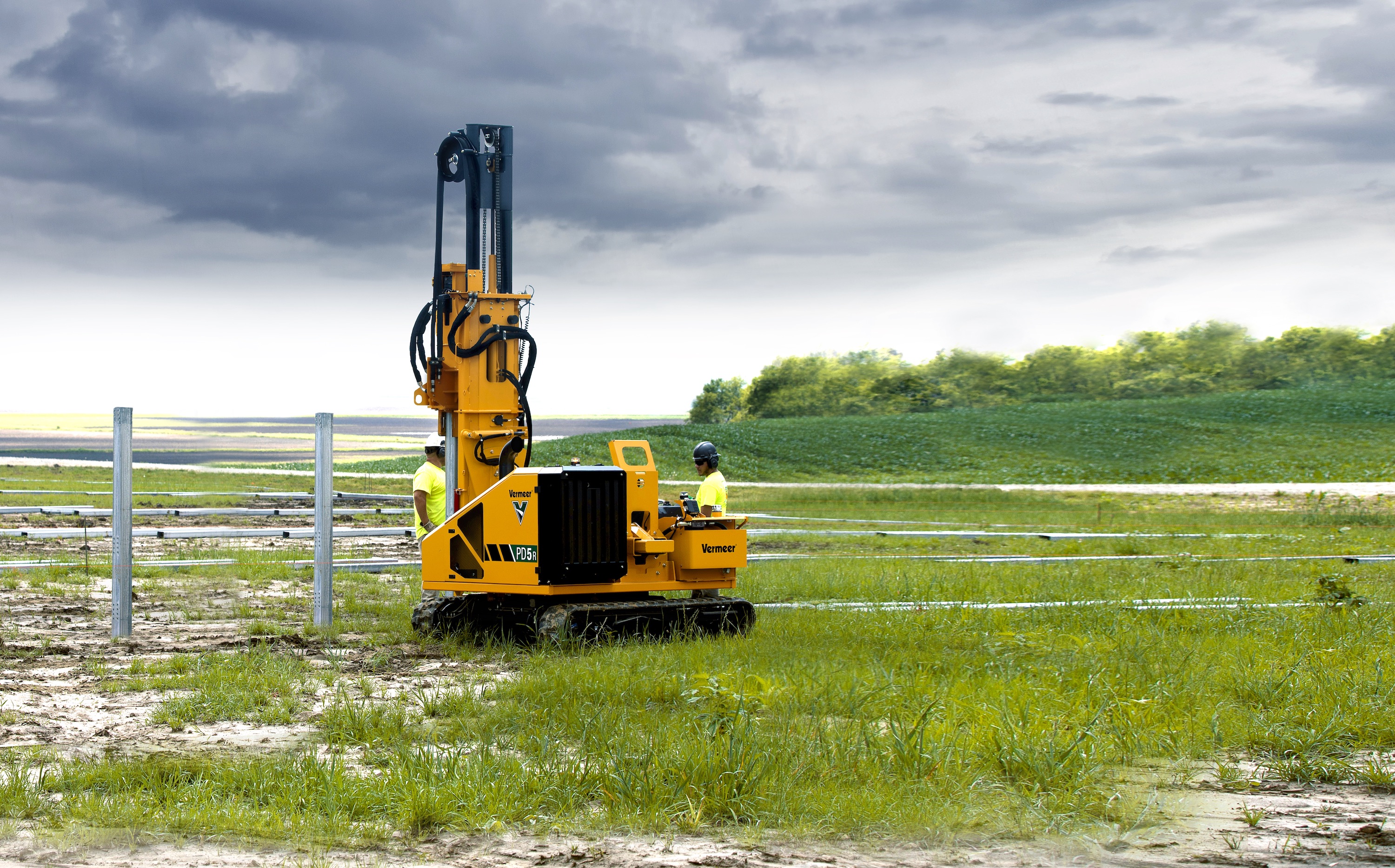 PELLA, Iowa, Oct. 15, 2019 — Vermeer is expanding its pile driver product line with the introduction of two new models. The Vermeer PD5 and PD5R pile drivers combine efficient operation and accuracy into a compact, lightweight machine well suited for working on smaller solar installation projects, congested jobsites and civil fencing and guardrail installation applications.